
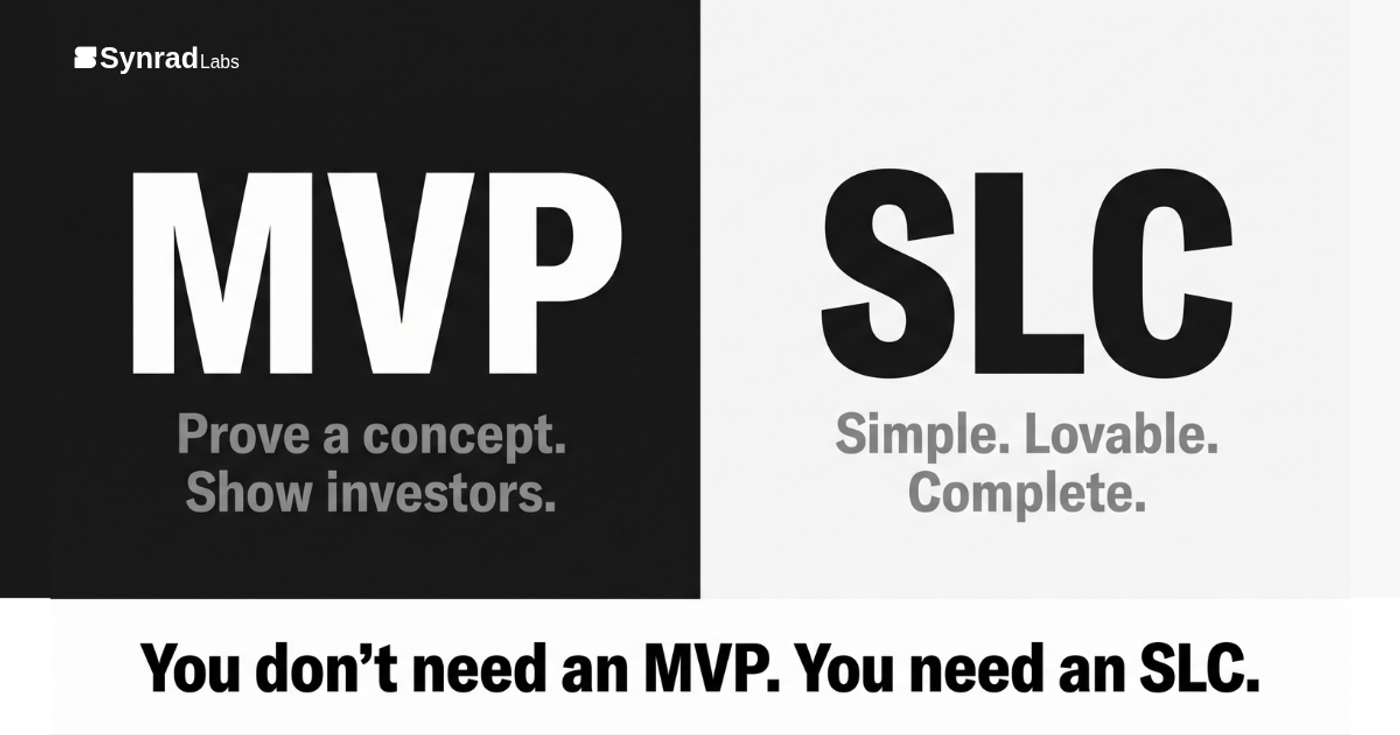
Every founder we talk to says the same word: MVP.
"We just want an MVP." "Can you ship the MVP in three weeks?" "Let's keep it small, it's only an MVP."
And almost every time, when we dig in for two minutes, it turns out they don't actually want an MVP. They want something else entirely. They just don't have a word for it yet.
This post is that word.
What an MVP actually is
A Minimum Viable Product is the smallest thing you can put in front of someone to learn whether an idea has legs. The keyword is learn. Its job is to answer a question, usually "do people care about this problem enough to pay attention or pay for this thing?" with the least amount of code possible.
The audience for an MVP is narrow and forgiving:
- An investor you want to demo to
- A design partner who agreed to try it
- One branch of one company you have a warm intro to
- A landing page with a waitlist
That's it :)
An MVP exists to de-risk the next dollar of investment in terms of your time, your money, or someone else's. It is a research instrument, not a product.
Where founders go wrong
Here's the move I see constantly. A founder is building, say, a food delivery app. They say "we'll start with an MVP."
Then, in the same breath:
"We want to launch in Tokyo, get the first 500 orders, and start generating revenue."
That is not an MVP. That is a product launch.
The moment you have real users, even ten of them paying real money, ordering real food, expecting real delivery then the rules change. They don't care about your hypothesis. They care that the app works. That payment goes through. That the order shows up. That when something breaks, someone responds.
An MVP cannot do those things, by definition. If it could, it wouldn't be minimum.
Hello SLC: Simple, Lovable, Complete
This is the term that most founders are looking for, and an SLC product is what you can actually give to real users, let me first quickly dissect this methodology.
Simple
You ship the core, not the kitchen sink. No dashboards nobody asked for. No settings page with 40 toggles. No extra features that you saw on a 8 year old giant app.
Lovable
What you do develop feels good. The flow makes sense. The design isn't fancy, but it isn't broken either. Users smile, not wince. It’s not a heavy app but it serves the purpose or the idea.
Complete
The value is delivered end to end. If you're a food delivery app, the user opens the app, orders food, pays, and the food arrives. Every step works. Nothing is "coming soon."
An SLC is what almost every founder actually wants when they say "MVP." It's small in scope but it's whole or rather I should say it’s complete.
The honest comparison
| MVP | SLC | |
|---|---|---|
| Purpose | Learn / Prove a hypothesis | Serve real users |
| Audience | Investors, design partners, internal demos | Actual paying customers (even just a few) |
| Feature set | Selective - whatever proves the point | The full happy path, end to end |
| Polish | Often rougher, can have visible seams | Has to feel good - "lovable" |
| Edge cases | Mostly ignored | The critical ones are handled |
| Success metric | Did we learn what we needed | Did users get the value we promised? |
Notice the rows that flip. An MVP can ship with a broken signup flow if you're walking the investor through it yourself. An SLC cannot, the user is alone, and the first broken thing is the last thing they see.
How to tell which one you need
Ask yourself one question:
Will a real user, with no one sitting next to them, try to get value out of this?
If the answer is no then you're showing it to investors, doing a pilot with one design partner, putting a video on a landing page, here an MVP is fine. Maybe even right.
If the answer is yes even if it's just ten people, even if they're friends, even if they're not paying yet, still you do not want an MVP. You want an SLC. Scope down hard. Cut features ruthlessly. But whatever survives the cut has to actually work.
What this means in practice
When we scope a build at Synrad Labs, the first question we ask founders isn't "what features do you want?"
It's "who is the first user, and are they alone?"
If they're alone, we plan an SLC. That usually means:
- One or two core flows, picked surgically
- Real auth, real payments, real error states and not stubs
- A design that's clean, not fancy
- No admin panel until you actually need one
- No "phase 2" features dressed up as launch features
The result ships in roughly the same timeline a "real MVP" would have because we cut scope twice as hard up front. The difference is that what ships is something a stranger can use without you in the room.
And no, just because it’s simple that doesn’t mean it’s not gonna work. Recall the v1 versions of Facebook, Instagram, WhatsApp, Zomato or Uber. They evolved over time and grew complex, of course the version 329 is better than version 1, but the core value was delivered in version 1 itself.
Focus on delivering the value.
The takeaway
MVPs are research. SLCs are products.
If you've got real users on the other end of the screen, don't call it an MVP and definitely don't build like it's one.
Build the smallest complete thing you can be proud of, and ship that.
Your users won't know the difference between an MVP and an SLC. They'll just know whether the thing worked.